Tunnel Mobile
The native endpoint where operators actually work.
Tunnel Mobile supports the approved capabilities and policies of the customer's Tunnel deployment from a native mobile endpoint. Content is encrypted and decrypted on the device. Credentials belong to the device. Nothing about the operator's communication requires trusting the infrastructure that carries it.
- Native mobile endpoint
- Device-bound credentials
- Endpoint-held keys
- Offline capable
Communication
The native operator endpoint, with the complete suite.
Content is sealed on the device and credentials are bound to it. Every mode below runs under mission-scoped, expiring authority.
MODE
Secure messaging
Direct and mission-scoped exchange between authorized endpoints.
CONTROLLED EVALUATION
MODE
Secure files
Carried under the same authority and the same sealed form as a message.
CONTROLLED EVALUATION
MODE
Private voice notes
Recorded and sealed on the endpoint before anything leaves it.
CONTROLLED EVALUATION
MODE
Secure voice calls
Live voice between authorized endpoints, with relay-assisted transport.
CONTROLLED EVALUATION
MODE
Secure video calls
Live video under the same authority model as voice.
CONTROLLED EVALUATION
MODE
Mission rooms
Controlled group communication scoped to a mission, not to a permanent contact list.
CONTROLLED EVALUATION
All six modes are implemented and verified by executed tests, and all six carry the same outstanding evidence: physical acceptance of the application path, which is tracked on Assurance and is not claimed here.
DEVICE
Per-device authority
Each enrolled device is independently identified, governed and revocable.
DEVICE
Device-bound credentials
A capability copied to another device does not function there.
DEVICE
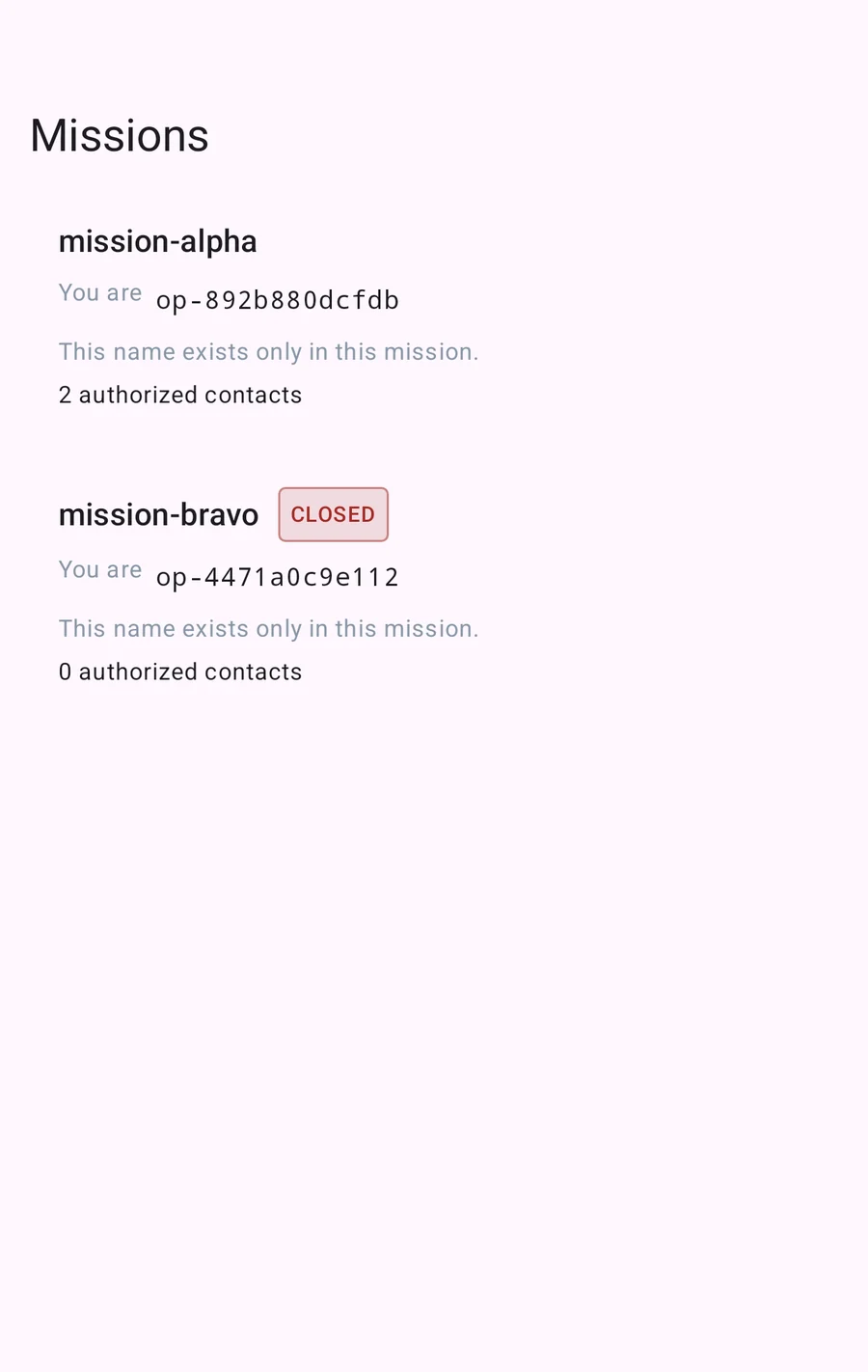
Mission-scoped authority
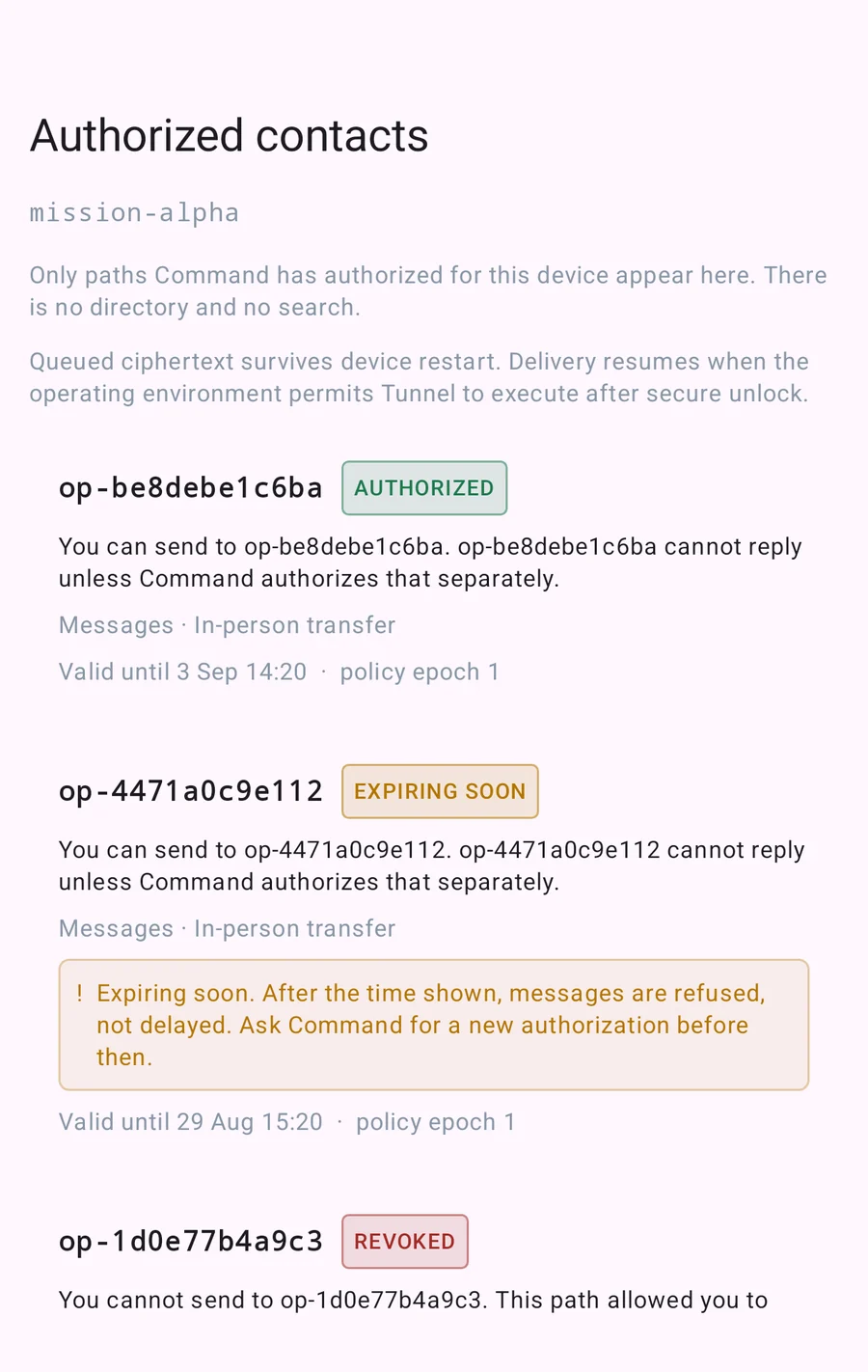
Authority can be constrained by mission context, relationship, capability, device and time.
DEVICE
Offline operation
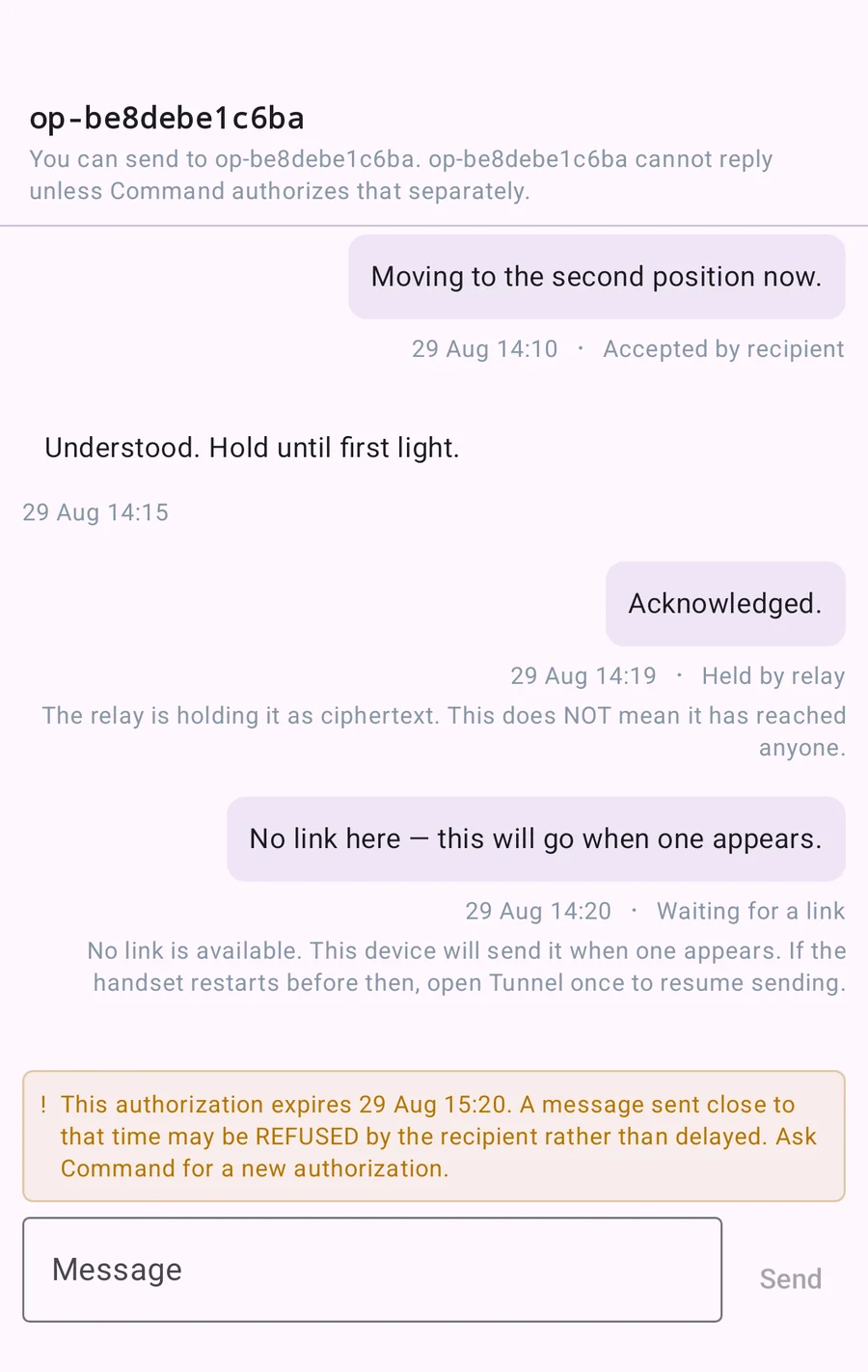
Composition, queueing and local exchange with no network present.
DEVICE
Controlled provisioning
Devices enter the deployment only through the customer's enrollment authority.
DEVICE
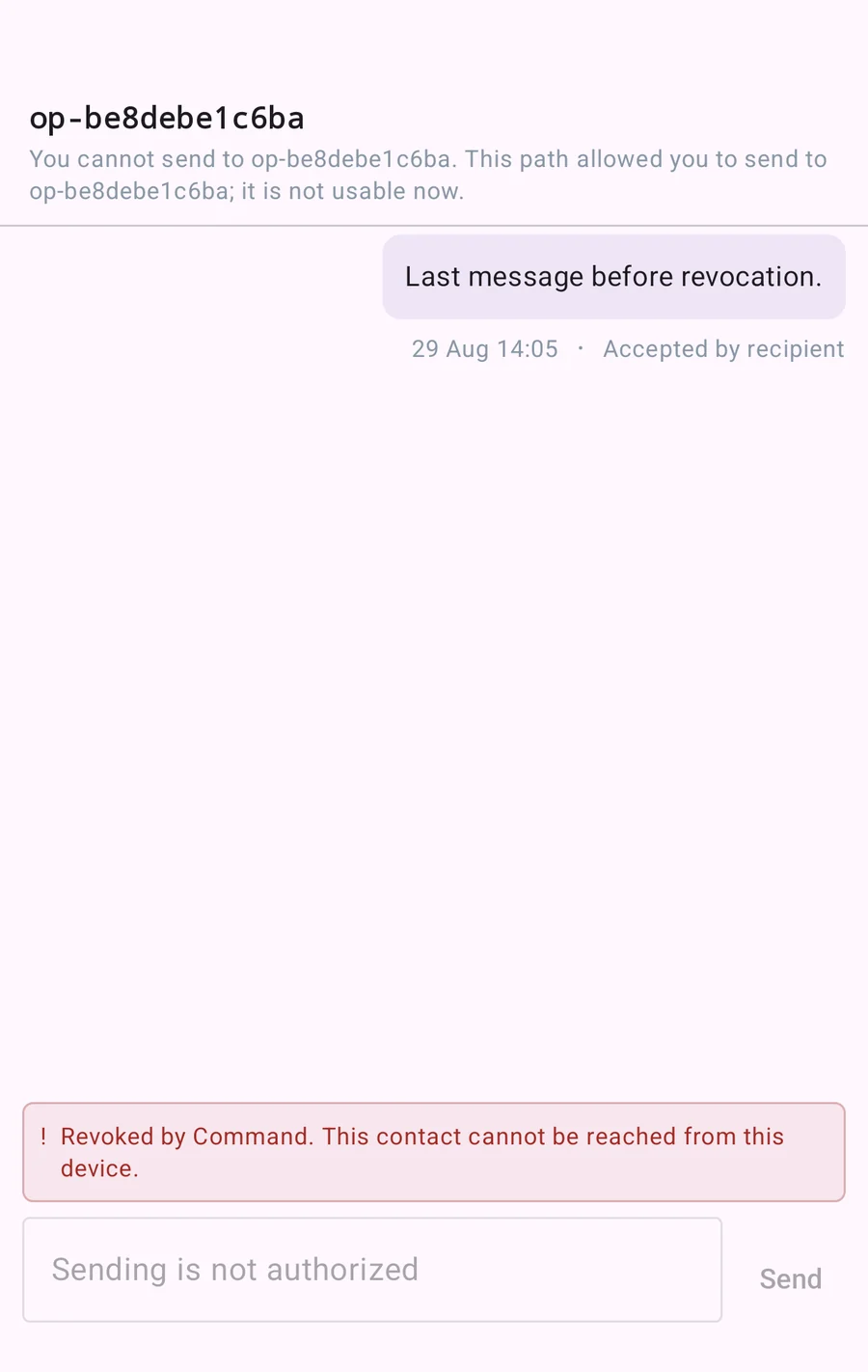
Revocation
A device is withdrawn without disturbing the operator's other devices.
The product
What an operator actually sees.
Authentic captures from the product's own visual tests, on real hardware, against synthetic data.
What operators get
A communication surface, not a security exercise.
The security architecture is the point, but it is not the experience. An operator opens the application and communicates; the platform enforces what the organization decided.
Secure messaging
Secure files and voice notes
Mission-scoped authority
Disconnected operation
Controlled provisioning
Per-device authority
On the device
Cryptography happens where the operator is.
Tunnel Mobile derives content keys on the endpoint. The platform's administrative components have no part in that derivation, and the relay carries the result without the means to open it.
- Device-binding key
- A P-256 key that proves this specific device. It is generated inside the platform's secure element where one is present, is not exportable, and authenticates the device to the deployment.
- Protocol signing key
- An Ed25519 key used for sender authentication on a Secure Mission Bundle. It signs; it never participates in key agreement.
- Protocol agreement key
- An X25519 key forming the classical half of hybrid key establishment.
- Post-quantum KEM key
- An ML-KEM-768 key forming the post-quantum half. No secure element on any current platform supports ML-KEM, so this key is hardware-wrapped rather than hardware-resident, and Tunnel states it that way.
- Payload key
- Derived on the endpoints from the agreement and encapsulation results. It exists only at the endpoints. No administrative component contributes an input to it.
Device lifecycle
A device that is lost is a device that can be withdrawn.
Because each device holds its own credentials and its own authorizations, withdrawing one device does not disturb the operator's other devices and does not require re-establishing the organization.
Revocation is bounded rather than instantaneous. A device that is out of contact applies withdrawal when it next receives newer signed state, or when its existing authority reaches the end of its validity window, whichever comes first.
Deployment profiles
One product family, separately governed builds.
Different deployment profiles require separately signed, configured and governed builds, because a managed deployment and a sovereign deployment are different trust domains. Externally this remains one product family: Tunnel Mobile.
- Deployment identity is fixed at build time, not chosen at runtime.
- A sovereign build accepts no commercial credential or endpoint.
- Signing identity and application identity stay separate per deployment.
- Policy distribution is signed and governed by the customer's authority.
Next step
See Tunnel Mobile in a deployment like yours.
An executive briefing walks through the operator experience, the enrollment and revocation model, and how the client behaves when the network does not.