Tunnel Command
Where the organization exercises authority, and only authority.
Tunnel Command is the native environment in which an organization governs its own communication: who is enrolled, which devices are trusted, which missions exist, who may communicate with whom, and when that permission ends. It governs the authorization structure the customer created. It is not a window into what people say.
- Native desktop
- Customer-controlled
- No content access
- Signed distribution
Administration
A native administration environment for the organization.
Command governs communication authority. It does not possess content keys or plaintext, and it does not observe message activity.
GOVERNS
Devices
Enrollment, certificate issuance, replacement and withdrawal.
GOVERNS
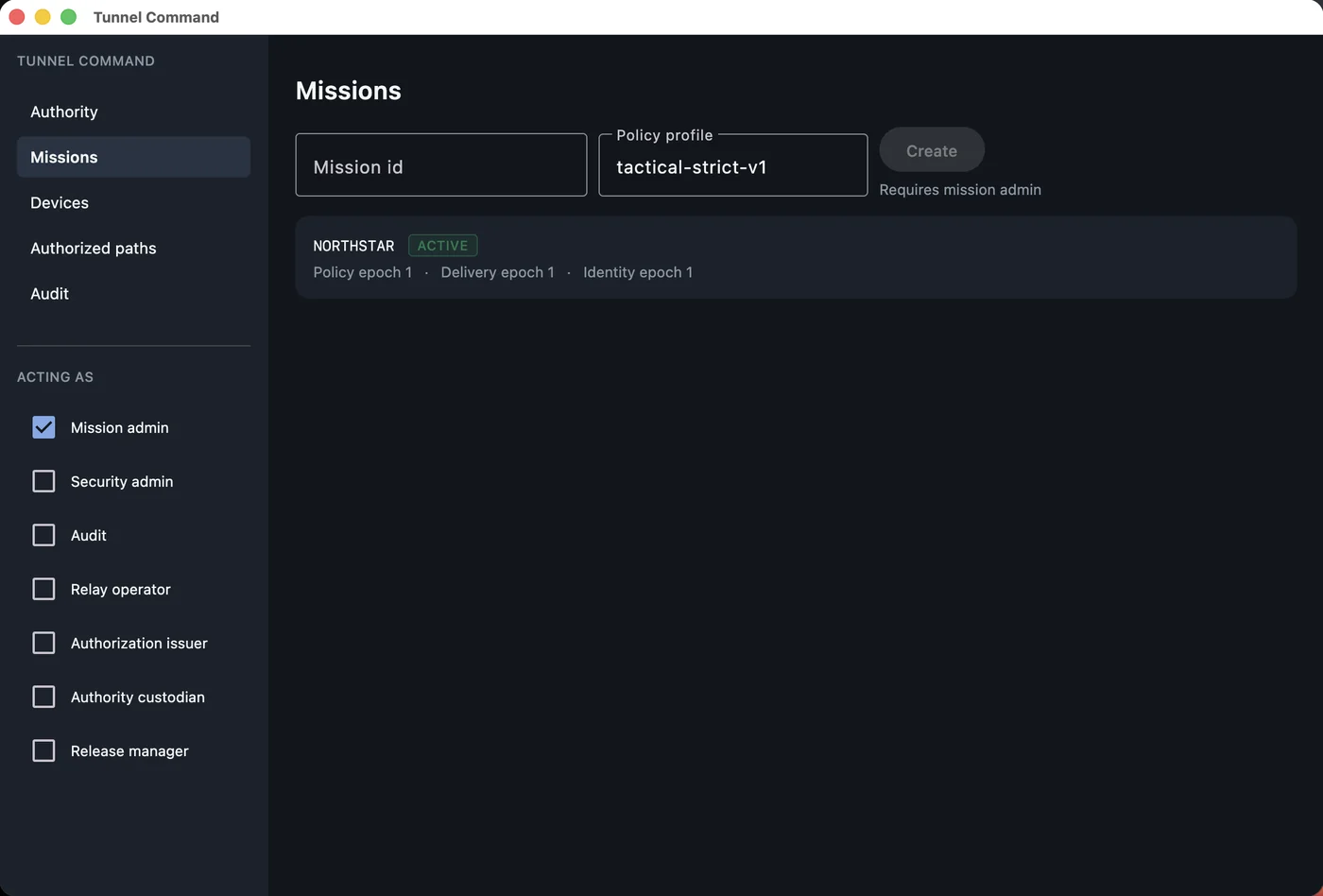
Missions
Creation, governance and closure as first-class objects.
GOVERNS
Directional relationships
Each authorized path issued explicitly, in one direction.
GOVERNS
Messaging authority
Who may exchange messages, with whom, until when.
GOVERNS
File authority
File exchange authorized separately from messaging.
GOVERNS
Voice and video authority
Live call capability authorized separately again.
GOVERNS
Mission rooms
Group scope governed as part of the mission, not as a contact list.
GOVERNS
Expiration
Every authorization carries a signed validity window.
GOVERNS
Revocation
Effective when the device receives newer signed state, or at expiry.
GOVERNS
Policy epoch
Advances when the rules governing a mission change.
GOVERNS
Delivery epoch
Rotates the addressing under which material is carried.
GOVERNS
Identity epoch
Advances when a device's standing changes.
GOVERNS
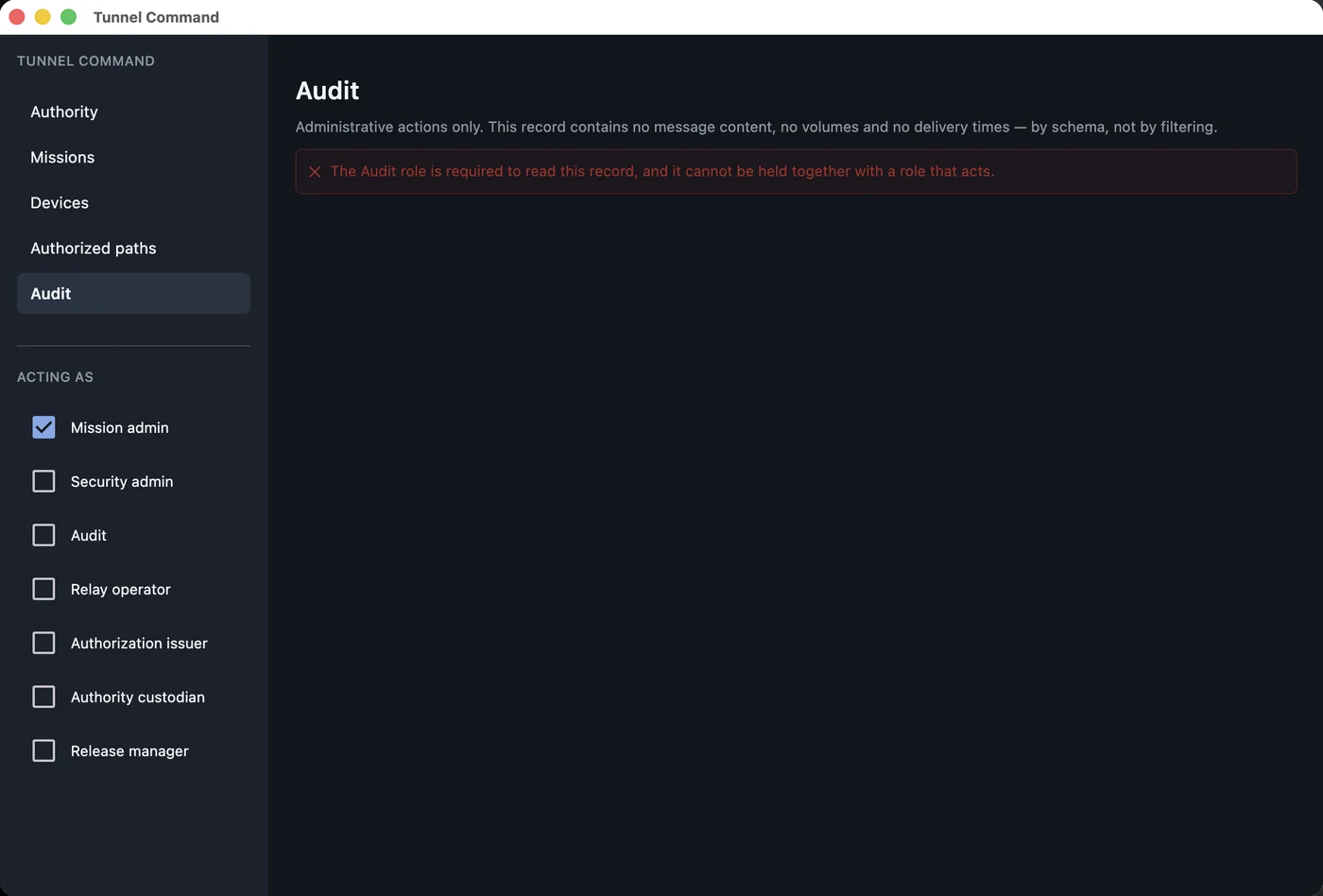
Audit
Administrative actions recorded, with no message content in the record.
GOVERNS
Role separation
Administration and audit held by different people, enforced.
GOVERNS
Signed policy
Policy and software reach devices under signature.
The product
What an administrator actually sees.
Authentic captures from the product's own visual tests, against synthetic data.
Functions
What an administrator does here
Command exists so that the answer to 'who decided this person may communicate?' is a record inside the customer's own domain.
Organization administration
Operator enrollment
Device enrollment and replacement
Mission and compartment administration
Communication-authority issuance
Device revocation
Credential expiration
Policy and transport policy
Relay administration
Controlled audit review
Incident coordination
Signed software and policy distribution
The boundary
Command governs communication. It does not read it.
This is the invariant the whole architecture is built to hold. The mission authority signs assertions about who may communicate. It holds a signing key, and a signing key cannot produce a key agreement.
- The mission authority holds an Ed25519 signing key. It has no key-agreement or decapsulation surface at all.
- Payload keys are derived on the endpoints from an X25519 agreement combined with an ML-KEM-768 encapsulation. The issuer of an authorization contributes no input to that derivation.
- Adding a signed authorization to a bundle changes what a relay may refuse to carry. It never changes what a relay may read.
- No administrator, Command instance or operator of the platform gains a plaintext capability by issuing or enforcing authority.
The authority that permits communication does not possess the keys required to decrypt communication.
Authority model
Permission is scoped, directional and finite.
Authority in Tunnel is issued for a mission, in a direction, for a capability, for a period. Nothing about it is ambient, and nothing about it is permanent by default.
Accountability
Customer-controlled, and therefore answerable to the customer.
In a sovereign deployment the administrative record lives in the customer's own audit domain. The organization does not have to ask a vendor what its own administrators did.
Next step
Walk through Command with your governance model in front of you.
An executive briefing covers role separation, mission structure, the authority lifecycle and how the administrative record works in your deployment.